Welcome to “Books in Review II,” the online-only column that complements “Books in Review,” which runs in The VVA Veteran, the bimonthly print magazine published by Vietnam Veterans of America.
That column and this site contain book reviews by writers who specialize in the Vietnam War and Vietnam War veterans. Our regular Books in Review II reviewers are John Cirafici, Kevin Hardy, Dan Hart, Bill McCloud, Mike McLaughlin, Harvey Weiner, Tom Werzyn, and Henry Zeybel. The late David Willson wrote hundreds of reviews for Books in Review II from its inception in 2011 through the spring of 2021. VVA Veteran Arts Editor and Senior Writer Marc Leepson assigns and edits the reviews.
Our goal is to review every newly published book of fiction, nonfiction, and poetry that deals with the Vietnam War and Vietnam War veterans. Publishers and self-published authors may mail review copies to:
Marc Leepson
Arts Editor, The VVA Veteran
Vietnam Veterans of America
8719 Colesville Road
Silver Spring, MD 20910
We welcome comments, questions, and suggestions at mleepson@vva.org
Dan Dana’s Diary of a Young Man: 1968-1969:Coming of Age at a Cultural Crossroads (Five Palms Press, 110 pp. $0.99, Kindle) is unlike any wartime journal I’ve ever read. At that’s a good thing.
Unlike any other, that is, because the book’s diary entries that cover his last two months in Vietnam and his worldwide travels afterward are based solely on the unedited words he wrote virtually every day more than 50 years ago. Words, by the way, that were not intended for any eyes other than his own.
Dana’s book begins in September 1968 in Qui Nhon, South Vietnam, as the young G.I. is dreaming of what it will be like after gets out of the Army. He has a frequent “urge to write” and a desire to fill up a variety of journals that he refers to as “books” once he’s completed them. He wants to write about things he considers to be “record-worthy.”
Interestingly, the book’s Foreword is written by VVA Veteran Arts Editor Marc Leepson, who served with Dan in the 527th Personnel Service Company on the outskirts of Qui Nhon in 1968. There’s even a grainy, black-and-white photo of the two of them in the book.
Dana writes that “several GIs” didn’t like the Vietnamese people because “they are not adopting American traits fast enough.” And: “Saigon is beautiful, so many trees. Nearly all of the streets around downtown are canopied with huge shade trees.” As for Vietnamese women, they “seemed to me physically beautiful,” he writes.
The diary covers Dana’s last few weeks of military service. He writes that he planned to make daily entries, and decided that on days when nothing much happened, he’d just say: “Nothing really worthy of petrification today.” Dana considers returning to school or maybe becoming a writer after his discharge.
“This book,” he writes, “is probably the most permanent thing I carry,” which is why he jots down all sorts of notes in it. At age 23, he hopes to get some traveling under his belt after ETSing in Vietnam before returning home.
Dan Dana
He goes on R&R to the Philippines and notes that the shorter he gets, the less he feels like writing. After coming back to the 527th, Dana begins smoking marijuana day and night, skips a reveille formation, and is punished by filling sandbags.
When he gets down to single digits, Dana, a life member of Vietnam Veterans of America, notes that he is already is experiencing feelings of nostalgia. Once he’s out, he’s determined to have some adventures before returning to school. We follow his time in Mexico sleeping on the beach, trying to grow a beard, and hanging out with hippies with all that entailed.
Dana adds more countercultural experiences, and ends the book with a series of haiku, such as:
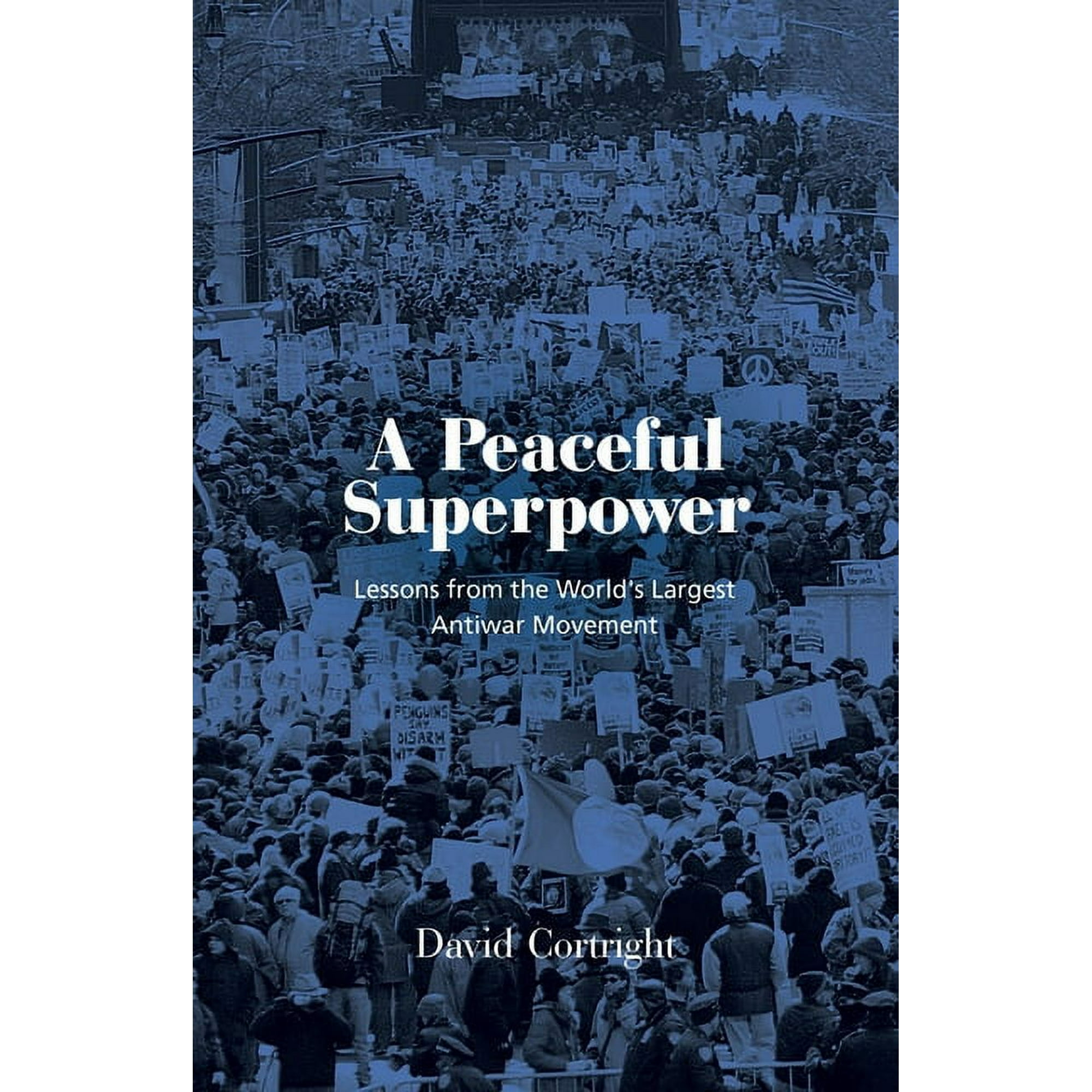
In a front-page New York Times in February 2002 article headlined, “A New Power in the Streets,” Patrick Tyler wrote: “The fracturing of the Western alliance over Iraq and the huge antiwar demonstrations around the world this weekend are reminders that there may still be two superpowers on the planet: the United States and world public opinion.”
That article provided the title for David Cortright’s new boo , A Peaceful Superpower: Lessons from the World’s Largest Antiwar Movement (New Village Press, 240 pp. $89, hardcover; $22.95, paper; $21.80, Kindle), on the movement to stop America’s invasion of Iraq. Cortright is a professor emeritus at the University of Notre Dame’s Kroc Institute for International Peace Studies and the author or editor of more than 20 books. That includes Waging Peace in Vietnam: U.S. Soldiers and Veterans Who Opposed the War and Soldiers in Revolt: GI Resistance During the Vietnam War.
Cortright is not just a scholar. A veteran of the Vietnam War, he has long been an antiwar activist who opposed the war as an active-duty soldier, served as the executive director for the Committee for a SANE Nuclear Policy, and led the organized opposition to the war in Iraq.
Cortright posits that the antiwar movement spawned by the Iraq War—by sheer numbers purported to be the largest ever organized—was a continuation of a multi-generational struggle for peace that emerged from the Vietnam War. Though the movement did not prevent the U.S. invasion of Iraq, Cortright argues that it influenced international politics and the White House decision-making process, ultimately undermining American objectives in the Middle East. The antiwar movement, Cortright believes, exerted decisive influence on public opinion.
The book is accessibly written, and when Cartwright wears his professorial hat, his analysis is cogent. He offers a sharp critique of the failings of democracy in the U.S. and the lack of accountability in the nation’s often-imperial foreign policy. He is also unafraid to critically examine the failings of the movement he helped lead, providing a utile history of the movement while revealing valuable insights into the technological and organizational innovations that allowed the undertaking to reach all corners of the globe.
But when Cartwright writes as a fervent organizer, he trends toward hyperbole, in which he forces causal connections that are merely correlated. In these cases, Cortright’s narrative reads like bits of encouragement to the younger generation of activists frustrated with their limited effectiveness in conventional politics.
Cortright, for example, points out that President George W. Bush’s decision to invade Iraq openly defied world public opinion. Nonetheless, one month before the invasion, more than 70 percent of Americans supported the use of military force against Saddam Hussein, including majorities in all age, education, and pollical affiliation groups.
David Cortwright
His assertion that Barrack Obama won 2008 presidential election as the anti-Iraq War candidate is equally specious. Obama did oppose the invasion of Iraq, but his election victory was based more on economic and cultural factors, with only 10 precent of those who voted for him mentioning his stance on the Iraq War.
Cortwright admits that his stance is not one of a “detached ivory tower,” and his stridency should be applauded. What he does not reckon with is, despite the size and scope of the movement, it may have been too little, too late. Much of the protest’s energy was overseas, where millions marched in England, Spain, and Germany, compared to tens of thousands in this country.
These quibbles aside, Cortwright has written an insightful and interesting book—part history, part memoir, and part “how-to.” It is a valuable contribution to the study of peace movements.
Attitude makes J. Richard Watkins’ 2011 Vietnam War memoir, Vietnam: No Regrets: On Soldier’s Tour of Duty (Bay State Books, 244 pp. $19.50, paper; $9.95, Kindle) stands out from other first-person stories of grunts in action. Watkins fearfully but voluntarily went to Vietnam in 1969 at the age of 22. Within six weeks, his fears of being killed transposed into feelings of elation when sent into battle.
During that time, he spent many sleepless nights on ambushes, avoided B-52 strikes, and helped to explore Viet Cong tunnels, but more importantly, Watkins was part of search and destroy missions humping through rice paddies and jungles, speeding in Brown Water Navy gunboats, and on helicopter assaults, which he found exhilarating.
Vietnam: No Regrets tells his story of serving with fellow Alpha Company grunts as an artillery spotter and radioman with the 25th Infantry Division’s 1/27 Wolfhounds in the Central Highlands, Iron Triangle, and east of Saigon out of Cu Chi. He also took part in the 1970 incursion into Cambodia. After ten months on the trail, Watkins accepted a rear-echelon job at the suggestion of his company commander. By then, his greatest fear was not being able to leave the adrenaline rush he found in combat behind.
Initially for Watkins, the Wolfhounds operated in a free fire zone. That mean they were free to shoot on sight and, in several cases killed Vietnamese who were not combatants. The Wolfhounds were not heartless, however. Watkins lauds the men who befriended him and introduced him to the wiles of warfare, especially his platoon leader, Lt. Barker.
Ambushes—in both directions—became a significant part of his life. He learned how to kill up close, regretted it at times, and tried to forget it. As an artillery pro, he doubled down as a rifleman when necessity dictated it, often more than that.
Exposure to gore and death hardened him to “tune out the possibility that I too could be wounded or killed,” he says. “I would just go with the flow of the situation. After awhile one doesn’t really believe he will be making it home anyway.”
His callousness toward himself did not extend to others, friend or foe. He viewed dead enemy combatants as people, just like anyone else who “had given their lives for a cause that they had believed in.” Scenes of dead soldiers remain with him to this day.
Joel Richard Watkins’ stories grow more interesting as his tour progresses. Life in the warzone became more complicated and survival more precarious. He found satisfaction in efforts such as destroying an enormous multi-level underground North Vietnamese base camp while recognizing the futility of the accomplishment.
Regardless, it all came down to “we were out there for the body count,” Watkins says, and recalls the days with no holds barred.
Vietnam: No Regrets includes 29 pages of photographs shot by Watkins.
Well-written Vietnam War fiction almost always borders on nonfiction. The parlance, the slang, and the idioms that emerged from America’s second-longest war are embedded deeply in the dialogue and the action. That is especially true with a novel written by a veteran who was there.
Barry Levy, a Canadian, did not serve in the military. But that hardly matters in his new novel, The War Machine (Double Dagger Books, 263 pp. $19.99, paper; $7.99, Kindle). In the book, Levy takes readers on a literary ride as realistic as the Vietnam War action in the movie, Platoon, and as indicative of the world back home as in The Deer Hunter.
The War Machine’s main character, David “Kick” Tacker, travels in his mind between his tours in Vietnam, and 1988, which finds him in Vancouver, British Columbia, attempting to make sense of his past and present.
“When Kick opens his eyes, he’s looking down at his cowboy boots, and notices they need a good shine,” Levy writes. “But there’s something weird about the floor. It looks runny. On the other side of the stall door, he sees the tiny bare feet of a child. He opens the door and finds the young Vietnamese girl he saw a few days ago. He’s been seeing her off and on for years. One of his boots is on her shoeshine box.”
Soon Kick is in Dusty’s Bar, remembering his first day in-country out loud for Kelly O’Leary, a Vancouver newspaper reporter. She only has an inkling about Canada’s connection to the Vietnam War until she interviews Kick and he fills her in on the particular horror of his tour of duty. Kick’s battle rattle makes readers feel as if they are in the thick of things in the war.
At the end of the book, Kelly O’Leary is before ABC-TV news cameras face to face with famed anchorman David Brinkley, telling his American audience–and the world–that to Canadians’ participation in the Vietnam War was far more than welcoming draft dodgers across the 49th Parallel.
The War Machine would be a fascinating addition to the bookshelves of Vietnam War veterans and students of the war, Canadians, and anyone else who does not know how deep Canada’s connection to the American War in South Vietnam really was.
Memoir is a tricky genre, and it is made even trickier when more than one voice is thrown into the same project. Christina Vo’s new memoir My Vietnam, Your Vietnam: A Father Flees. A Daughter Returns (Three Rooms Press, 360 pp. $18, paper; $9.99, e book) amplifies the trickiness by adding a fraught familial and national relationship, as the book is interspersed with her father Nghia M. Vo’s self-published memoir, The Pink Lotus.
Father and daughter share a bond, Christina Vo writes, but “hardly interact with each other.” So, the connection between her memoir about finding herself and her Vietnamese heritage as a young woman and her father’s memoir about fleeing South Vietnam in the later years of the war is initially bound by faith alone.
Ten years after the publication of her father’s memoir, Christina Vo writes, she was living in Vietnam, and “the epiphany came to me that I would one day share his story.” That story is the book we have today, an experimental sort of conversation through time between a daughter finding her way in Vietnam as a born-and-raised n American, and a father trying to integrate his origins with a new life as an American physician.
The format enriches the stories particularly in the way father and daughter speak to each other emotionally. Trauma is shared as the daughter’s melds her father’s life with her own.
There is something beautiful about the synchronicity of this kind of structure: A daughter hears a song in Saigon in 2003 that she recognizes as the same one her mother sang to her and one she thought she lost to time. Meanwhile, in the 1950s, her father describes returning to a lotus pond tended to by monks in Vung Tau again and again to try to recapture “an image of serene tranquility that symbolized Vietnam emerging from colonialism.”
The father’s story is deeply political – he is quite angry with the communists in Vietnam whom he blames for his exile in America – while the daughter’s story is more personal, a journey for meaning involving working with nonprofits and receiving graduate school fellowships. Christina’s Vo’ life is undeniably robust and compelling on its own, but the dissonance between the austerity and self-abnegation of her father’s chapters and the introspection of Christina’s can be jarring.
Christina Vo with her father, Nghia M. Vo
Ultimately, this book represents a project of familial reconciliation that is difficult for readers to appreciate because many important aspects of the father-daughter relationship are left out of the book. Christina’s friend who asks about her father in the afterword, for example, is surprised to hear that she and her father never really talk.
In sum, Christina Vo has written a lovely and compelling book that, due to the ambition and candor of its structure, at times feels less like a memoir and more of an assertion that Vietnam, the country, represents a loss and a division that can be felt through multiple generations. It also, however, does not always feel like her father’s text agrees with that, leading to an sometimes-disorienting reading experience.
Legacy of Lies: A John Moore Mystery (Hellgate Press, 375 pp. $14.95, paper; $2.99, Kindle) is the third novel in Ed Marohn’s exciting CIA-thriller series. These are not stories of a CIA analyst sitting in his office in Langley, Virginia. John Moore is a field agent who is consistently in danger as he plies his trade around the world.
Moore likes to stay busy to keep his mind off of his experiences in Vietnam during the war where he served as an Army infantry Captain and the loss of his wife to cancer. Ed Marohn, a life member of Vietnam Veterans of America, served in Vietnam with the 25th Infantry Division and the 101st Airborne Division, and has taught military history at the University of Nevada. His previous titles in the series are Legacy of War and Legacy of Evil.
John Moore says his CIA boss had “a knack for placing me in difficult and dangerous situations because of my military combat experience.” His boss, for his part, tells him, “I have no other agent that I trust more. You have something that outshines me and everyone I have ever worked with—your honesty and ethics.”
Moore is sent to Nairobi, Kenya, in 2003 to meet a delegation from the Socialist Republic of Vietnam. A business deal may be in the works between China and Kenya that could be of interest to the U.S and to Vietnam. Before long, a kidnapping takes place and all hell breaks loose.
While in Kenya Moore experiences more than one reminder of his time in the Vietnam War. He takes daily anti-malaria pills, for one thing, remembering how important they were when he was in Vietnam. When he eats a Kenyan meal it reminds him of the times that he had shared meals with Montagnards. He thinks of the Viet Cong when he sees Africans wearing sandals made from old tire treads. At one point, walking in darkness, he recalls the sounds and smells during a similar situation in Vietnam. For Moore, “the mental stress from the Vietnam War never seemed to go away.”
When he learns that he may need to be wary of fellow agents, he sleeps with his Sig Sauer P229 pistol strapped to a holster on his waist. He will shoot people. He will get shot. He will jump into a rolling Cessna Caravan as it’s about to take off.
This action-packed thriller takes place over a two-week period. Once you begin, it won’t take you anywhere near that long to read it. Legacy of Lies is another winner from Ed Marohn.
Retired USAF Lt. Col. Thomas R. Waldron so often declared the men with whom he flew in Vietnam to be “heroes” that it is little wonder he made the word the key part of the title: I Flew With Heroes: A True Story of Rescue and Recovery during the Vietnam War Including the Raid at Son Tay (CreateSpace, 172 pp., $13.25 paper; $6.50, Kindle), first published in 2012. Clearly, Waldron himself served heroically in the war.
Few non-aviators would care about the details of flight training, airplane operation, and the Air Force’s way of assigning pilots to different aircraft, but Waldron’s inclusion of these and other details about each stage in his career—including why he switched from large fixed-wing planes to large Jolly Green rescue helicopters—are clues to understanding why he was a great pilot.
Even without anyone shooting at you, there are a lot of things that must work perfectly to keep a helicopter in the air. Pilots must know and understand each one of those things, but they also must check and recheck them every time they take off and land and know instantly what to do if just one of them stops working. That doesn’t even count other factors such bad weather or bullets, rockets, and missiles being fired at you. Waldron’s attention to detail makes his story interesting and awe-inspiring.
I was glad, however, that I joined the Navy and not the Air Force way back when. The thought of being high in the sky in a thin-skinned machine that could drop like a stone if just one thing went wrong combined with flying it into a hornet’s nest of hot antiaircraft shells, was too crazy to imagine. And yet that’s exactly what Thomas Waldron and other helicopter pilots did, mission after mission. Some didn’t survive, and Waldron writes about them, too.
He recounts the events of November 21, 1970, when he was part of a mission to rescue 61 American POWs at the Son Tay Prison camp 27 miles west of Hanoi. More than 12,000 North Vietnamese troops were within five miles of the prison. The mission went according to plan, but the POWs had been removed from the camp days before. The good news was that the only casualty was one American soldier who took a gunshot wound to the leg.
Blue Ghost: A Helicopter Pilot Writes Home from 1968 Vietnam (Platypus Publishing, 282 pp. $33.62, hardcover; $17.97, paper: $6.99, Kindle) contains one of the best records of an individual’s time in the Vietnam War that I have read. It basically consists of more than 70 letters written by Army helicopter pilot Thomas Pueschel to his family, with historical background added by his brother Larry.
Thomas Pueschel, of Holyoke, Massachusetts, had a boyhood dream of learning to fly, suggesting it would be like “singing love songs to the sky.” He enlisted in the Army in February 1966 and had Basic at Fort Polk. After a year of training at the Army Primary Helicopter School at Fort Wolters and Aviation School at Fort Rucker, he was promoted to Warrant Officer and received his wings. He took additional training at the Army Armor Center at Fort Knox before getting his orders to Vietnam.
Thomas Pueschel would serve in the war from October 1967 until December 1968, flying more than 900 combat assault missions, mainly in Huey gunships with the 17th Air Cavalry, and later in his tour, in the Americal Division in the newer Cobras when they arrived in-country.
He tried to send a letter home at least every two weeks. In one of the first letters he wrote to his parents he said, “I am plain scared.” Among the things, he asked his parents to send flashlight batteries, stationery, scissors, and cookies.
Pueschel early on began to question the reasons for the war. Sometimes he wrote that his letters were being sent from “the asshole of the world,” and sometimes from “never, never land.”
Much of his time was spent at the Chu Lai Combat Base with a unit dubbed the Blue Ghosts. Early in his tour he wrote his parents: “Yesterday, we received some automatic weapons fire from inside one of the villages, so we levelled the village, and I mean that literally!” He later wrote about flying escort for General Westmoreland for a short time.
7th Squadron/17th Cavalry troopers in-country with a Cobra attack helicopter
Pueschel volunteered to help a unit involved in heavy fighting that was short of pilots. and wound up taking part in the big, bloody Battle of Dak To. He received the Distinguished Flying Cross for providing close air support for a ground unit that was “outnumbered and in grave danger.”
He didn’t share everything with his parents. He wrote his brother, for example, that he had put a rocket between the legs of a “gook” and “blew him to hell and gone again.”
Thomas Pueschel died in 2019. His brother Larry has put together a great tribute to his service, which also just happens to be a fine record of the war in 1968, its most deadly year.
Leo Flory’s 101st Airborne Combat Medic Transition to Duty with the Screaming Eagles in Vietnam, 1968-1969 (Elm Grove Publishing, 374 pp. $29.99, hardcover; $18.99, paper) is an updated second edition of Flory’s 2011 Vietnam War memoir.
A combat medic whose pacifist parents forced him to go through military training as a conscientious objector, when Flory arrived in Vietnam in 1968, he was offered an M-16 when he reported for duty with the 2nd Battalion of the 501st Infantry Regiment in the 101st Airborne Division in Hué. He took it.
The postscript to the new edition adds the reactions of many of Flory’s comrades-in-arms and others to the first edition. It also adds info about subsequent unit reunions.
In 2009, Leo Flory received an email from the niece of a 101st Airborne trooper killed in Vietnam. She wanted to know more about her uncle. Flory, who did not know the man, began a quest to learn more, which he did, and he gave the information to the niece. He dedicates the book to the uncle and the uncle’s story is the framework of the memoir.
The book is comprised mainly descriptions of the horrific day-to-day activities of being a combat medic in an infantry unit. Of particular interest are the variety of jungle creatures Flory encountered. Besides the rats, ants, land leeches, big bats, huge centipedes, and humongous beetles, he saw an orangutan, a green bamboo viper, and a 16-foot python, which his unit captured and kept as a pet.
Flory also discusses his in-country encounter with Chris Noel, whose radio show, “A Date with Chris,” on Armed Forces Radio was a big GI morale booster. There is an online petition to help get Chris Noel the Presidential Medal of Freedom. You can sign it at honorchrisnoel.com/about-chris-noel
Bill Matelski, Michael Roberts, and David Clausius of Flory’s unit in Vietnam, August 1969
The book also contains one of the saddest Dear John stories I’ve ever heard. One of Flory’s buddies in Vietnam was married with one child. He and his wife made plans to meet in Hawaii for his R&R, and he sent most of his pay home for their care and to fund the trip. The day finally came when he left for his R&R.
His wife met him at the airport in Honolulu, but instead of his young daughter in hand, she introduced him to her new boyfriend and handed him a set of divorce papers to sign. She told him that she and her boyfriend had just spent a glorious week in Hawaii and needed to catch their plane home in a few minutes. He signed and they disappeared.
He later learned that his ex-wife had cleared out their bank accounts. He had to spend his R&R week licking his marital wounds and then return to the jungle and the war.
A few nitpicks about the book. First, Flory refers to the the enemy (and the Vietnamese in general) as “gooks.” Even understanding the need to dehumanize the enemy, this racist word was frowned upon by many at the time and is all the more distasteful now.
Second, Flory describes narrow bamboo bridges, which were a challenge for big Americans to negotiate, but he does not identify them. They were commonly known by Americans as “monkey bridges,” as only a monkey had the dexterity to cross one safely.
Finally, Flory misspells and misinterprets the word “Chiew-Hui” [sic]. The program by which the enemy rallied to our side was the Chieu Hoi (“Open Arms”) program. An individual who rallied under was called a “Hoi Chanh.”
These are minor distractions in a book that seems to be based mainly, or perhaps exclusively, on memory. Plus, it’s rare that a war memoir has a second edition.
Historian William Nester relegates the Vietnam War to a mere second act in a long play about the Cold War. In setting the stage for his latest book, World of War: A History of American Warfare from Jamestown to the War on Terror (Stackpole, 472 pp. $39.95, hardcover; $28.99, Kindle), Nester analyzes the attitude of Americans toward the world at large. He begins by saying, “Americans are among history’s most war-prone people.”
At the same time, Nester cites the foundation of American culture as humanism and individualism, fortified by idealized and romanticized history. Hero worship, he says, has motivated many Americans in many ways. Nester also recognizes imperialism and hegemony as American traits.
A professor of government and politics at St. John’s University in New York, William Nester has written more than three dozen books on national security, military history, and the nature of power.
In World at War, he contends that Americans never lacked reasons for entering into warfare, but says that how commander-in-chief presidents justified entering conflicts has significantly differed, particularly in scale. War entails what Nester classifies as physical (hard) and psychological (soft) powers. In equal physical battles, he says, the “side with greater soft power will win.” In essence, diplomatic, economic, and political power complement military power. These truths apply to revolutions as well as wars between nations.
Speaking of leadership, Nester says that politics and psychology are as inseparable as war and peace. He quotes Henry Kissinger saying it is delusional “to believe that leaders gain in profundity while they gain experience…. The convictions that leaders have formed before reaching high office are the intellectual capital they will consume as long as they continue in office.”
Within this framework, Nester deconstructs the nation’s array of wars during four centuries of American history.
He argues that the Vietnam War provided a wealth of mediocre and dismal examples of civilian and military leadership. At times, Nester relies on multiple sources to prove this point. For example, when he says, “Eventually nothing ultimately discredited the global containment strategy [of France and the United States against communism] worse than the Vietnam War,” he lists thirteen books that buttress that conclusion. He examines strategy from a lofty level and blames America’s missteps on a lack of insight by those with the power to rectify it.
World of War reviews the many American strategies we pursued in the Vietnam War from the time of Harry Truman’s administration through Richard Nixon’s. For people well-versed in the history of the war, reading accounts of U.S. actions from the Battle of Diên Biên Phú in 1954 to the communist takeover in 1975 is like reading headlines of the era.
“Only three American programs achieved some success because they tried to balance hard and soft power,” Nester says: the Combined Action Program (CAP), the CIA counterinsurgency Operation Phoenix, and the strategic hamlet Civil Operations and Rural Development Support (CORDS) program. Two of the three were soft actions.
A Vietnam War CAP Marine on a “soft action” job
By categorizing the Vietnam War as but one episode in the Cold War, Nester foretells a diminishing of America’s hard and soft powers as a world leader. For anyone interested in American history beyond the Vietnam War, World of War offers 400 years of interesting and colorful drama with plenty of good and bad actors.






 Books in Review II